Project SunNest
Course or Client
D-Lab: Design
Project Partner: National Innovation Centre Nepal
Status
Started February 2025
Ended August 2025
Contributions
Thermodynamics
Design
Manufacturing
Project Overview:
In Nepal, the government faces a massive public health crisis: maternal mortality rates in rural Himalayan communities spike in the winter months when the outside temperature routinely drops below freezing. Despite efforts by the state to establish more birthing centers, actual use rates are low due to a lack of consistent heating with many people instead choosing to give birth in unhygienic conditions without qualified medical staff at home. To combat freezing temperatures with limited consistent electricity access, I worked in a team to design and build a solar powered heating system consisting of an energy collector and a novel hot water radiator-storage tank.
Background:
The challenge of creating a heated birthing center in Nepal is due to a lack of significant and reliable electricity coupled with poor building practices. With the majority of Nepal's main grid electricity coming from only a few hydroelectric plants, very high or low temperatures can lead to gross deficits in the already limited energy available. Most birthing centers are constructed with concrete walls and sheet metal roofing and, while waterproof and earthquake resistant, these materials are very poor insulators. At least one skilled birthing attendants (SBAs) is required to always be on duty and as many as four people (including birthers, caregivers, and family members) can be in a standard 3 meter by 3 meter by 3 meter birthing room. Cost and transport of materials are often the largest barriers to new technologies being implemented in the rural, mountainous regions of Nepal as the monsoon season makes passage impossible. Historically, heating via biomass combustion is the preferred method of heating in Nepali homes with dung being a frequently used but pathogenically dangerous and ineffective fuel source.
The Solution:
A solar-thermal water heater system that is earthquake resistant, manufacturable in Nepal, assembleable onsite without the use of heavy machinery, easily cleanable, low cost, and locally repairable. To address the lack of heating using solar energy (chosen for it high availability and renewability), the system had to meet three functional targets: efficiently collect, store, and deliver the energy to the room.
The Design Process:
Modeling
During the spring semester, my team and I focused on creating a model to determine the energy needed to properly heat the cement and steel birthing room in Himalayan climate. Using that model, it was possible to determine the amount of energy needed to offset heat leakage and test a proof of concept prototype solar collector.

Figure 1: The thermal model comparing varying building geometries during the coldest time of the year.

Figure 2: Environmental vs interior temperature of the cube building model with varying insulations during the coldest time of the year.

Figure 3: Environmental vs interior temperature of the cube building model with varying window sizes (unglazed glass) during the coldest time of the year.
For a first version, I proposed a solar energy collector created by bending copper tube to coil in an S shape inside a rectangular wooden box with a solar powered pump to push cold water through the system to an S shaped radiator. Early designs focused on space saving by adding solar collection panels to birthing center walls as well as the potential to add a combustion component for especially cold or dark periods.


Figure 4: Early concept drawings of the solar collector and hybrid solar-combustion system.
Water was chosen over air as the heat conductor because of its higher heat capacity; gram for gram, water requires about four times as much energy to increase its temperature by one degree Kelvin thus reducing temperature fluctuation when absorbing solar energy. Unfortunately, calculations quickly revealed that the amount of water necessary to store enough energy to heat a room would be greater than the volume of water allowed by a solar collector and radiator alone, so a storage tank was incorporated for future iterations. By bending metal tube instead of welding straight tubing, it was hoped that complicated manufacturing methods could be avoided. However, upon trying to bend the copper tubing, it was found that obtaining the small bend radius necessary to maximize surface area without kinking the pipe was near impossible.
First Prototypes
Learning from the copper tubing test, the design was changed to incorporate galvanized steel tubing with PVC connectors to create bends. Two tubing styles were considered: an accordion and S shape. With the accordion style, water is allowed to flow faster through the system with less reductions in head pressure, but lower time to absorb energy from the sun due to its faster flow rate. The S shape allows water to flow slower through the system (thus allowing more energy to be absorbed by the sun while inside the collector), but leads to significant reductions in head loss. At this point, the team was still operating under the assumption that use of a solar powered pump was possible, so water pressure was not a significant concern and both designs were tested. No major differences in heating were detected at this small scale, so it was decided to model the larger prototypes for construction and testing in Nepal.

Figure 5: Testing the accordion (left) and S (right) shape tubing patterns on a 1/4 scale.
Nepal Prototypes
Based on the lessons learned at small scale with regards to sealing and light exposure, extra care was taken in the next round of prototypes. In one version of the solar collector, I proposed a trapezoidal geometry which was meant to increase solar energy absorption during the beginning and end of sunlight hours by having one face of the absorption tube array be almost perpendicular to the sun's rays. This design was eventually discarded due to manufacturing and water pressure concerns, despite the potential benefits of water storage inside the unit and increased efficiency at dawn and dusk hours. Building off the designs from our preliminary tests, I designed two full sized (2m by 1m) solar collection piping systems for use in the solar collection panel, an accordion and S-shape.

Figure 6: Trapezoidal solar collector design.
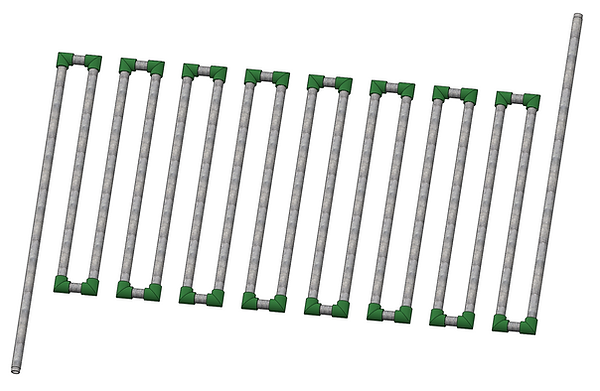
Figure 7: S-shape solar collector piping design.

Figure 8: Accordion shape solar collector piping design.
It was discovered, however, that commercially available solar powered pumps would not be repairable or affordable enough for use in our project in Nepal. After calculating the head loss to push water through the collector and a radiator system, it was determined that only a very high powered pump (costing over 1000 USD) would be sufficient in providing enough pressure. Instead, the thermosyphon effect (utilizing temperature differentials to move fluid through a system) and a single massive storage tank was integrated into the system to take the place of a mechanical pump. For this, I created a convertible radiator-insulated tank. The first iteration was constructed out of recycled oil drums, but it became evident that rust compromised the structural integrity of most recycled parts in Nepal due to the humid climate. Thus, the second iteration was designed and created out of welded galvanized steel sheets with openings for piping to connect to the collector at the top (hot water) and bottom (cold water).


Figure 9: First (left) and second (right) iterations of the water tank-radiator (removable insulation not pictured).

Figure 10: Full scale constructed radiator.
While time and the monsoon season prevented complete testing in Nepal, a full scale solar collector was designed and built. From there we decided to scrap the meltable plastic connectors serving as the pipe junctions due to leakage issue and instead weld the joints to a rectangular steel tube for easy of manufacturing and assembly.

Figure 11: Full scale solar collector piping.

Figure 12: Full scale solar collector with steel collection plate, galvanized steel piping, wooden case, and glass top).
As part of my final deliverables, I produced designs and instruction guides for the radiator-tank with plans for the removable insulation as well as the design and instruction guide for the piping of the solar collector. Overall, this was an incredible experience whose results are soon to be implemented in several test sites across Nepal and I am incredibly thankful for NIC Nepal for the opportunity to work on such an impactful project. In an effort to continue progress on the project, it was decided to open source all of the designs; for more information or a potential collaboration please email myself or NIC at mahabir@nicnepal.org.

Figure 13: The MIT D-Lab team after finishing our first full scale solar collector prototype in Nepal.
Radiator-Tank Assembly Plans
Solar Collector Box (1m Internal Pipes)
Solar Collector Box (2m Internal Pipes)
Assembly STEP Files